
Couples Therapy vs Marriage Counseling: Which Do You Need?
When your relationship needs professional support, the search for help often raises more questions than it answers. The terms couples therapy vs marriage counseling appear everywhere, online, in conversations with friends, even from practitioners themselves, yet they're rarely explained clearly. Understanding the distinction matters because choosing the wrong service could mean investing time and resources into an approach that doesn't address your actual needs.
This guide breaks down the real differences between these two options so you can move forward with confidence. At Luxury Perspectives, Rhonda Baker, LMFT, works with individuals and couples who refuse to settle for generic advice, people who want targeted expertise matched to their specific circumstances, delivered with the privacy and professionalism they expect.
Below, you'll find a direct comparison of how each approach works, who benefits most from each, and what to consider before scheduling your first session. Whether you're navigating early relationship challenges or working through years of built-up patterns, this breakdown will help you identify which path actually fits where you are right now, and where you want to go.
The clear difference between couples therapy and marriage counseling
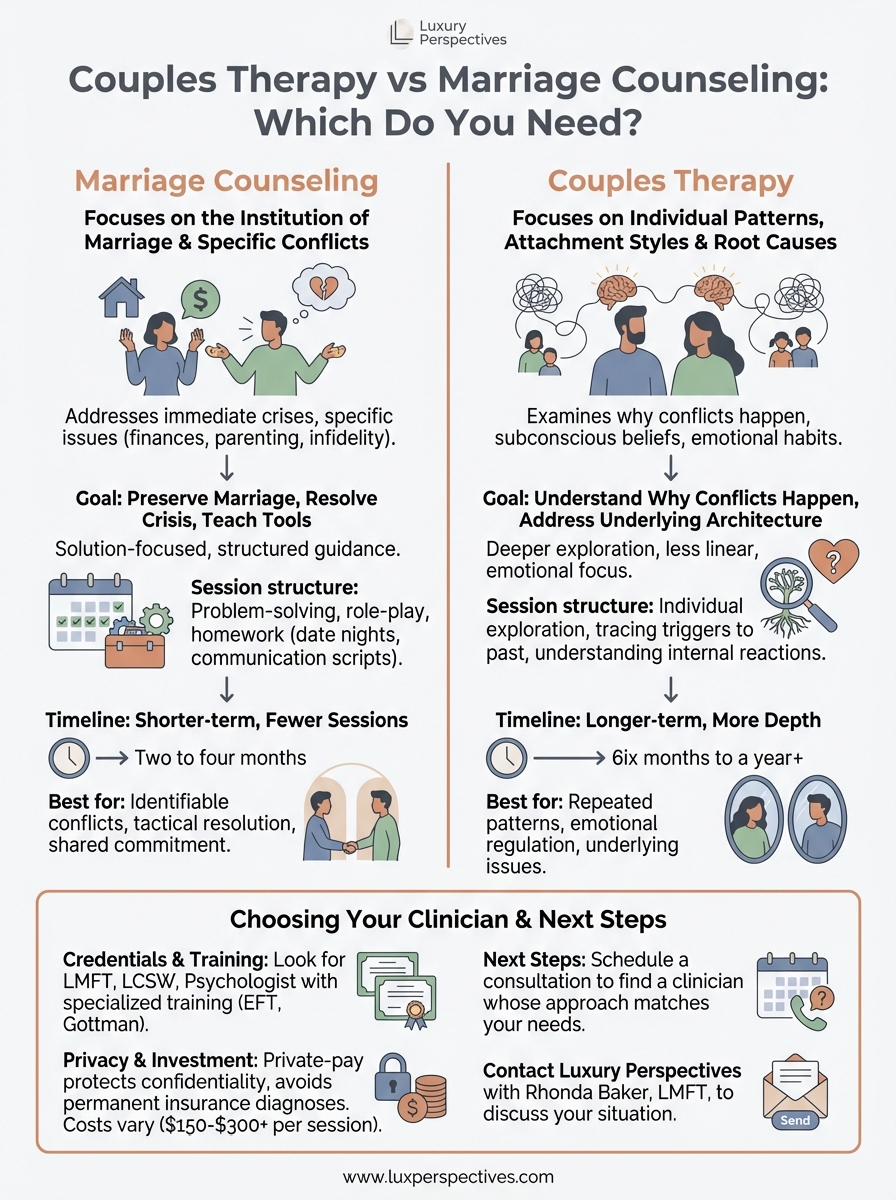
The debate around couples therapy vs marriage counseling stems from a genuine difference in scope and methodology, not just marketing language. Marriage counseling traditionally focuses on the institution of marriage itself, addressing specific conflicts that threaten the marital bond. Your counselor typically works to resolve disagreements about finances, parenting decisions, household responsibilities, or infidelity. The goal centers on preserving the marriage and teaching you conflict resolution tools that apply directly to married life.
Couples therapy takes a broader approach that extends beyond marital status. You don't need a marriage license to benefit from this work because the focus sits on individual patterns, attachment styles, and how each person's history shapes the relationship dynamic. This method examines why conflicts happen rather than just how to manage them, digging into the subconscious beliefs and emotional habits that drive recurring problems.
What marriage counseling actually addresses
Marriage counseling operates with a solution-focused framework designed to stabilize relationships in crisis. Your counselor helps you identify immediate conflicts and implements strategies to reduce tension in your home. Sessions often concentrate on communication techniques, compromise skills, and behavioral changes that produce measurable improvements in how you interact as spouses.
When your marriage faces specific, identifiable problems that need targeted intervention, marriage counseling provides the structured support to address those issues directly.
This approach works best when you can pinpoint concrete issues that, once resolved, would significantly improve your relationship quality. Your counselor might assign homework between sessions, such as scheduled date nights or communication exercises, to reinforce new patterns in your daily life.
What couples therapy targets instead
Couples therapy positions you and your partner as two separate individuals who bring distinct histories, wounds, and coping mechanisms into the relationship. Your therapist explores how childhood experiences, past relationships, and learned behaviors create the current dynamic. Rather than focusing solely on the presenting problem, this work uncovers the root patterns that generate multiple surface-level conflicts.
Sessions in couples therapy frequently involve individual exploration within the joint session, where your therapist helps each person understand their own triggers and responses before addressing the interaction between you. The therapeutic relationship itself becomes a tool for change, as your therapist models healthy boundaries and communication that you can internalize over time.
The practical implications of choosing one over the other
Your decision between these approaches should reflect where you are and what you need. Marriage counseling suits couples who share a commitment to the marriage and need tactical guidance through a specific challenge. The timeline tends to be shorter, with clear benchmarks for when the work is complete.
Couples therapy requires more time and depth because it addresses the underlying architecture of your relationship. You might enter therapy to solve one problem and discover that multiple patterns need attention before sustainable change occurs. This path demands patience and willingness from both partners to examine uncomfortable truths about themselves, not just about the relationship.
How each approach works in practice
When you enter either setting, the session structure and clinical techniques reveal the fundamental difference between these modalities. Your experience in marriage counseling centers on identifying specific conflicts and implementing behavioral changes within a relatively short timeframe. The counselor directs conversations toward problem-solving, often asking you to role-play difficult conversations or practice communication scripts during the session. You leave with homework assignments designed to shift how you interact at home, such as implementing weekly check-ins or using "I" statements during disagreements.
Couples therapy sessions unfold differently. Your therapist spends considerable time exploring individual histories and emotional patterns before addressing the relationship dynamic. Sessions might involve one partner talking while the other listens without responding, allowing the therapist to help each person understand their internal reactions and where those responses originated. The pace feels slower because the work targets deep-rooted patterns rather than surface behaviors.
The marriage counseling session experience
Your marriage counselor typically follows a structured agenda that keeps sessions focused on the presenting issue. You start by reporting on progress since the last meeting, discussing what worked and what didn't with the tools you received. The counselor then addresses new conflicts or deepens work on existing problems, teaching you specific techniques to manage those situations more effectively.
Marriage counseling sessions prioritize measurable progress through concrete skills that you can apply immediately to reduce conflict and improve daily interactions.
Most counselors assign between-session tasks that reinforce the work, giving you tangible actions to practice before you return. This approach creates accountability and allows the counselor to track whether the interventions actually change your behavior at home.
The couples therapy session experience
Couples therapy sessions feel less linear. Your therapist might spend an entire session exploring why one comment triggered an intense reaction, tracing that response back through your history. The distinction in couples therapy vs marriage counseling becomes obvious here: therapy prioritizes understanding over immediate solutions. Your therapist helps you recognize patterns you've carried forward from childhood or past relationships, patterns that now sabotage your current partnership without your conscious awareness.
Which one fits your situation
Your relationship circumstances dictate which approach serves you best, and understanding the distinction between couples therapy vs marriage counseling helps you avoid wasting time on the wrong intervention. Marriage counseling works when you face identifiable conflicts that need tactical resolution: you're arguing about money every month, you disagree about parenting styles, or infidelity recently occurred and you need guided repair work. Both partners must share commitment to the marriage and willingness to learn new communication patterns.
Couples therapy fits when you recognize repeated patterns that persist across multiple issues. You've tried talking through problems on your own but find yourselves having the same fight with different details, or one partner shuts down while the other pursues connection. This dynamic signals deeper patterns at work, patterns that require exploration beyond behavioral adjustments.
When marriage counseling is the right choice
You benefit most from marriage counseling when your marriage functions reasonably well except for specific problem areas that create ongoing tension. The conflicts feel manageable with the right tools, and you believe that learning new skills would resolve the immediate stress. Your counselor teaches you these skills directly and expects you to implement them between sessions.
Marriage counseling provides the focused intervention you need when clear problems have clear solutions, and both partners want to strengthen their commitment through structured support.
When couples therapy makes more sense
Choose couples therapy when you notice that surface conflicts mask something more complex. One or both partners struggle with emotional regulation, or past trauma affects how you show up in the relationship. You might feel disconnected from each other despite resolving individual arguments, or you question whether the relationship can sustain long-term growth. Therapy addresses the underlying architecture rather than just the visible cracks, which requires patience and willingness to examine uncomfortable truths about yourself.
What to expect and how to choose a clinician
Your first session establishes the therapeutic relationship that determines whether the work succeeds. Most clinicians schedule an intake session where you describe your relationship history, current challenges, and what you hope to achieve. The therapist assesses whether their approach matches your needs and explains how they work. You should leave this initial meeting with clarity about the treatment framework and realistic expectations for progress. If something feels off, trust that instinct and schedule consultations with other clinicians before committing to ongoing work.

What the first session actually looks like
Expect your clinician to ask detailed questions about your relationship timeline, major conflicts, family backgrounds, and previous attempts to resolve issues. Both partners share their perspective while the therapist observes how you communicate, where you interrupt each other, and what patterns emerge even in this controlled setting. Your therapist explains their approach to the couples therapy vs marriage counseling question and how their methodology addresses your specific situation. The session ends with a proposed treatment plan that outlines session frequency, anticipated duration, and the therapeutic goals you'll work toward together.
Your first session reveals whether the clinician creates space for both partners to feel heard and whether their expertise matches the depth of work your relationship requires.
Credentials and training that matter
Verify that your clinician holds a state license as an LMFT (Licensed Marriage and Family Therapist), LCSW (Licensed Clinical Social Worker), or psychologist. These credentials require graduate-level training and supervised clinical hours specifically in relationship work. Ask about their specialized training in couples therapy or marriage counseling, particularly in modalities like Emotionally Focused Therapy (EFT), Gottman Method, or psychodynamic approaches. Years of experience matter, but specialized training in relationship dynamics matters more than general clinical experience. You want someone who has dedicated their professional development to understanding how partnerships function and fail, not someone who occasionally sees couples alongside individual clients.
Costs, privacy, and insurance considerations
The financial and privacy aspects of seeking relationship support deserve careful consideration before you commit to either approach. Session costs for couples therapy vs marriage counseling vary widely based on the clinician's credentials, location, and whether you use insurance. Expect to pay between $150 and $300 per session for a qualified LMFT or psychologist in most markets, with rates climbing higher in major metropolitan areas or for clinicians with specialized expertise. The total investment depends on session frequency and duration, which typically ranges from eight to twenty sessions for marriage counseling and potentially longer for couples therapy given its deeper scope.
The financial investment you're making
Marriage counseling tends to require fewer overall sessions because it targets specific conflicts with a solution-focused approach. You might complete the work in two to four months if both partners actively implement the tools between sessions. Couples therapy requires a longer timeline, often six months to a year or more, because you're addressing fundamental patterns that took years to develop. Calculate your total investment by multiplying the per-session rate by the anticipated number of sessions, recognizing that deeper work costs more over time but potentially delivers more sustainable change.
Why privacy matters in relationship work
Insurance coverage creates a permanent record that includes a mental health diagnosis for at least one partner. That diagnosis becomes part of your medical history and can affect future insurance applications, security clearances, or employment in sensitive fields. Private-pay eliminates this documentation requirement, keeping your relationship work completely confidential. Your therapist maintains only the records necessary for treatment, and no third party reviews your case or dictates how many sessions you receive. This privacy protection matters particularly for high-achieving professionals who want clinical expertise without compromising their personal information.
Private-pay models protect your confidentiality by removing insurance companies from your therapeutic relationship entirely, ensuring that what you discuss stays between you, your partner, and your clinician.
Insurance coverage and what it means for you
Most insurance plans provide limited coverage for couples therapy or marriage counseling, typically requiring that one partner receive a diagnosable mental health condition to justify reimbursement. Even with coverage, you face copays, deductibles, and session limits that may not align with your actual treatment needs. Out-of-pocket payment gives you complete control over your treatment timeline and removes the administrative burden of dealing with insurance authorizations and claim denials.
Next steps for your relationship
Understanding the distinction between couples therapy vs marriage counseling gives you the clarity to choose the right path forward. Your decision should reflect where your relationship actually is, not where you wish it were or where others think it should be. If you're facing specific conflicts that need tactical resolution, marriage counseling provides the structured framework to address those issues directly. When you recognize deeper patterns that persist across multiple areas of your life together, therapy offers the exploration necessary for lasting change.
Schedule consultation sessions with clinicians whose training matches your needs. Prepare questions about their approach, expected timeline, and how they measure progress. Both partners need to commit fully to the process, whether you choose short-term counseling or deeper therapeutic work. Contact Luxury Perspectives to discuss your specific situation with Rhonda Baker, LMFT, and determine which approach serves your relationship best. Your willingness to invest in professional support already signals strength, not weakness, in your partnership.