
Emotional Intelligence for Leaders: Skills, Tips, And Growth
Technical skills and industry expertise can get you into a leadership role. Staying there, and thriving, requires something different. Emotional intelligence for leaders has become the defining factor that separates managers who struggle to connect with their teams from those who build lasting influence and drive measurable results.
You've likely noticed this pattern yourself: some leaders have all the credentials yet create tension wherever they go, while others seem to naturally earn trust and loyalty. The difference isn't charisma or luck. It's a set of learnable skills rooted in self-awareness and intentional emotional regulation. Without these capabilities, even the most technically qualified professionals hit a ceiling, one they often can't see until the damage is already done.
This article breaks down what emotional intelligence actually means in a leadership context, why it directly impacts your team's performance, and the specific skills you can start developing today. At Luxury Perspectives, we work with professionals and leaders who recognize that inner work creates outer results, and that investing in emotional intelligence is investing in both career longevity and personal well-being. Whether you're navigating workplace conflict, building a high-performing team, or simply want to lead with greater intention, what follows will give you a practical foundation to grow.
Why emotional intelligence matters for leaders
You can't lead effectively if you can't manage yourself first. Emotional intelligence for leaders determines whether your team follows you out of obligation or genuine commitment. Research consistently shows that the most successful leaders share a common trait: they recognize their emotional patterns, understand how those patterns affect others, and adjust their behavior accordingly. This skill set directly impacts retention rates, productivity levels, and workplace culture in ways that no amount of technical expertise can replicate.
The cost of low emotional intelligence
Leaders who lack emotional awareness create ripple effects that extend far beyond their own performance. Your inability to recognize frustration in your voice, your tendency to dismiss concerns without hearing them fully, or your habit of making decisions when emotionally reactive costs your organization in measurable ways. Teams led by emotionally unaware managers report higher stress levels, increased turnover, and lower engagement scores according to workplace research across industries.
These consequences compound over time. When you consistently misread social cues, respond defensively to feedback, or fail to acknowledge the emotional reality of your team members, you erode trust. People don't leave companies, they leave managers, and the common thread in those departures is often a leader who never learned to connect beyond transactional exchanges. Your team members stop sharing concerns, stop bringing forward innovative ideas, and start doing the minimum required to avoid negative interactions with you.
The cost of replacing an employee can range from one-half to two times their annual salary, and much of that turnover stems from leadership dynamics rather than compensation issues.
How EQ drives team performance
Teams mirror the emotional patterns of their leaders. When you demonstrate self-regulation under pressure, your team learns to do the same. When you acknowledge mistakes openly and adjust course without defensiveness, you create psychological safety that allows others to take calculated risks and innovate. This dynamic doesn't happen by accident. It requires deliberate attention to your internal state and conscious effort to model the behaviors you want to see replicated throughout your organization.

Your ability to read the room changes outcomes in real time. Recognizing when someone needs support versus when they need space, understanding which team members respond to direct feedback versus collaborative problem-solving, and sensing tension before it escalates into conflict are all practical applications of emotional intelligence. Leaders who develop these skills reduce miscommunication, resolve conflicts faster, and build stronger working relationships that translate directly into better project outcomes and higher quality deliverables.
The competitive advantage of emotionally intelligent leadership
Organizations increasingly recognize that technical skills become obsolete, but emotional intelligence remains relevant across changing market conditions and technological disruptions. You bring stability to your team during uncertainty not through false optimism but through authentic acknowledgment of challenges paired with grounded confidence. This combination requires knowing yourself well enough to separate your anxiety from reality and understanding others well enough to meet them where they are rather than where you wish they would be.
Leaders with high emotional intelligence attract and retain top talent because people want to work for someone who sees them as whole human beings rather than productivity units. Your capacity to balance results-driven accountability with genuine care for your team members' growth creates loyalty that survives difficult seasons. When competitors offer higher salaries but worse leadership dynamics, emotionally intelligent leaders keep their best people because the intangible benefits of working in a psychologically healthy environment outweigh purely financial considerations for many high performers.
The gap between adequate leadership and exceptional leadership almost always comes down to emotional intelligence. You may have reached your current position through technical mastery, strategic thinking, or sheer determination. Reaching the next level requires something different: the willingness to look inward with the same rigor you apply to external challenges and the commitment to develop skills that make you someone others genuinely want to follow.
What emotional intelligence looks like at work
Emotional intelligence for leaders manifests in specific, observable behaviors rather than abstract qualities. You see it when a manager notices a team member's unusual quietness during meetings and asks a private follow-up question instead of assuming everything is fine. You see it when someone receives harsh criticism in a public forum yet responds with curiosity rather than defensiveness, asking clarifying questions to understand the concern fully. These moments reveal whether a leader has developed the capacity to manage their internal reactions while remaining attuned to the people around them.
Daily interactions and communication
Your communication patterns reveal your emotional intelligence level more than any assessment tool. Leaders with developed EQ adjust their approach based on who they're speaking with and what that person needs in the moment. You might deliver direct, results-focused feedback to one team member who prefers clarity and brevity, while offering more context and collaborative problem-solving to another who processes information differently. This flexibility requires constant awareness of how your words land and willingness to modify your natural style when it serves better outcomes.
Leadership communication isn't about finding one perfect approach; it's about recognizing that different people require different methods to feel heard and motivated.
The daily check-in becomes a diagnostic tool rather than a formality when you pay attention. You notice when someone's tone shifts, when their usual enthusiasm dims, or when body language contradicts their verbal responses. Emotionally intelligent leaders don't ignore these signals. They create space for honest conversation, recognizing that unaddressed concerns eventually surface as performance issues or relationship breakdowns.
Conflict resolution in action
Workplace tension tests emotional intelligence immediately. You demonstrate EQ when you pause before responding to an accusatory email, choosing to schedule a conversation instead of firing back a defensive reply. You show it when mediating between team members by acknowledging both perspectives without taking sides prematurely, helping each person feel understood before moving toward resolution. These actions require managing your own discomfort with conflict while holding space for others to work through theirs.

Decision-making under stress
High-pressure situations expose whether you've truly developed emotional regulation or simply avoid triggering circumstances. Leaders with strong EQ recognize when stress affects their judgment and implement checks before making significant decisions. You might step away for ten minutes, consult a trusted colleague, or sleep on a choice rather than reacting immediately. This self-awareness prevents impulsive decisions made from anxiety or frustration that you'll later need to walk back or repair.
The core EQ skills leaders need
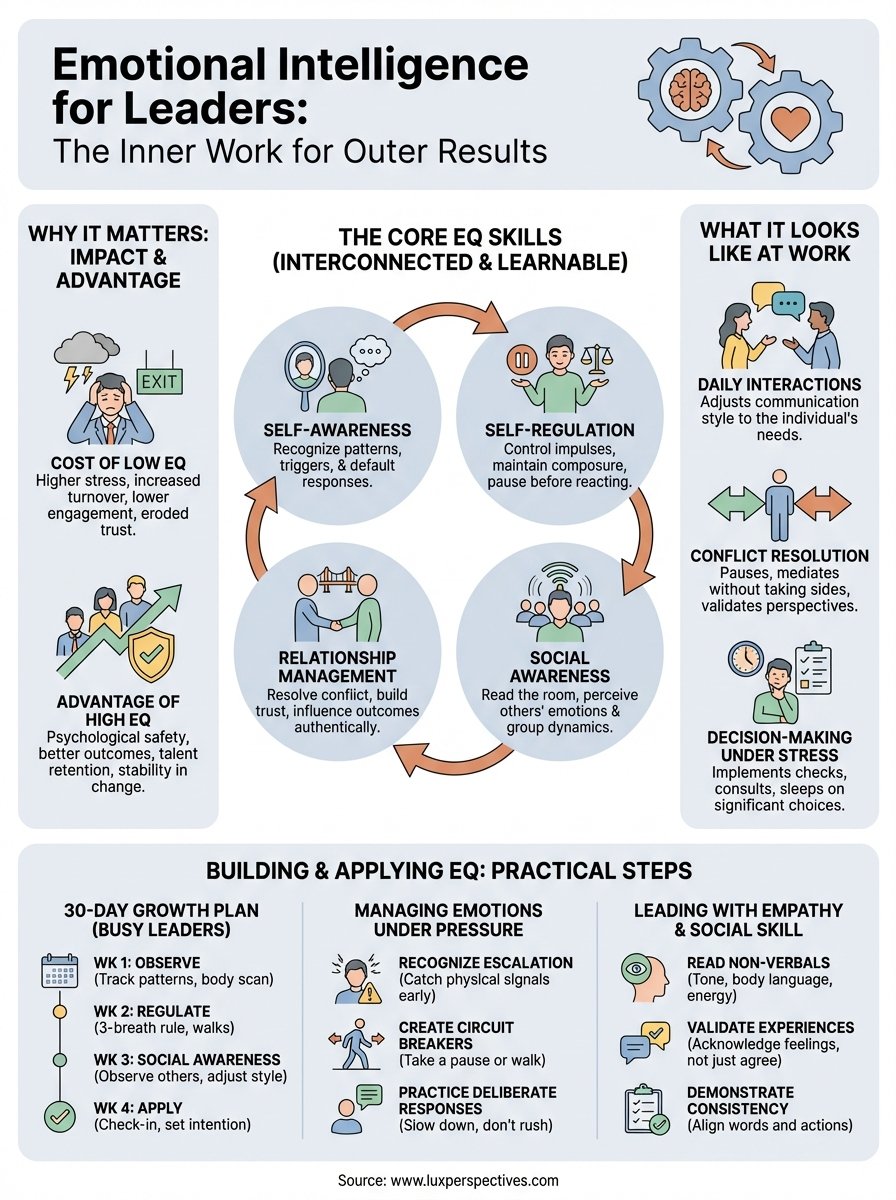
Emotional intelligence for leaders breaks down into four distinct skill areas that build on each other. You can't master relationship management without first understanding yourself, and you can't effectively regulate your emotions if you lack awareness of them in the first place. These competencies work as an integrated system rather than isolated abilities, and developing one naturally strengthens the others over time. Most leaders find they have natural strengths in one or two areas while needing deliberate practice in the others.

Self-awareness
Your ability to lead others begins with understanding yourself. Self-awareness means recognizing your emotional patterns, triggers, and default responses before they dictate your behavior. You develop this skill by paying attention to physical sensations that accompany different emotions, noticing the thoughts that precede reactive behavior, and identifying the situations that consistently challenge your composure.
Self-awareness isn't about achieving perfect emotional control; it's about catching yourself in the moment and choosing your response rather than reacting automatically.
Leaders with strong self-awareness know when they're stressed before it affects their decision-making. You recognize that your impatience during afternoon meetings stems from low energy rather than your team's incompetence, or that your tendency to micromanage intensifies when you feel uncertain about project outcomes. This recognition creates the space needed to adjust your approach rather than letting unconscious patterns damage relationships.
Self-regulation
Knowing your emotions means nothing if you can't manage them effectively. Self-regulation involves controlling impulsive reactions, maintaining composure under pressure, and adapting your emotional expression to match what the situation requires. You demonstrate this when you feel angry but choose to pause and respond thoughtfully rather than unleashing frustration on your team.
Effective self-regulation doesn't mean suppressing emotions or pretending everything is fine. Instead, you acknowledge what you're feeling internally while choosing how and when to express it externally. Leaders who master this skill can feel anxious about a company restructuring yet communicate with steadiness that keeps their team grounded rather than amplifying collective panic.
Social awareness
Reading the room separates adequate leaders from exceptional ones. Social awareness means accurately perceiving emotions in others, understanding group dynamics, and recognizing unspoken concerns that affect team performance. You sharpen this skill by observing body language, listening for what people don't say, and paying attention to shifts in energy or engagement during interactions.
Relationship management
All previous skills culminate in your ability to navigate relationships effectively. Relationship management encompasses conflict resolution, motivating others, building trust, and influencing outcomes without resorting to positional authority. You apply this when coaching someone through performance challenges, mediating team disputes, or inspiring commitment to difficult goals through authentic connection rather than manipulation.
Common signs your EQ needs work
Most leaders don't recognize their emotional intelligence gaps until those gaps create visible problems. You might believe you're managing yourself effectively while your team experiences a completely different reality. These blind spots develop because self-perception rarely aligns with how others experience your leadership, and without honest feedback or intentional reflection, patterns persist unchecked. Recognizing warning signs gives you the opportunity to address issues before they compound into career-limiting problems or team dysfunction.
You react instead of respond
Your immediate reactions reveal whether you've developed emotional regulation. Leaders with underdeveloped EQ snap at team members during stressful moments, send terse emails they later regret, or make impulsive decisions when feeling pressured. You know this applies to you if colleagues describe you as unpredictable, if people wait to approach you when you seem calm, or if you frequently need to apologize for how you handled situations.
Physical tension accompanies reactive patterns in ways you might not notice but others definitely do. Your jaw clenches during challenging conversations, your voice gets louder when questioned, or your body language closes off when hearing unwelcome information. These automatic responses signal that emotions control you rather than the reverse, a clear indicator that emotional intelligence for leaders remains underdeveloped in your case.
People avoid giving you feedback
When your team stops bringing you concerns, problems, or honest opinions, you've created an environment where people don't feel safe being direct with you. This avoidance manifests in several ways: team members suddenly agree with everything you suggest, conflicts get resolved without your involvement, or you hear about issues only after they've escalated significantly.
If you're consistently the last person to know about team problems, your reactions have taught people that honesty carries too much risk.
Defensiveness kills feedback loops faster than any other leadership behavior. You might think you handle criticism well, but if your first response involves explaining why the feedback doesn't apply, providing context that shifts blame elsewhere, or dismissing concerns as misunderstandings, you've signaled that feedback isn't actually welcome. Leaders with strong EQ receive input with curiosity rather than justification.
You struggle to read the room
Your inability to sense emotional shifts in your environment creates constant miscalculations. You keep pushing for agreement when everyone has mentally checked out, continue with planned agenda items when the team needs to address an elephant in the room, or miss obvious signs that someone needs support. This blind spot leads to mistimed jokes during serious moments, tone-deaf communications during organizational stress, and persistent confusion about why your well-intentioned efforts land poorly.
Misreading social dynamics damages relationships incrementally. Each missed signal adds to a pattern where people question whether you understand them at all. You might feel surprised when valued employees resign, confused when team morale drops despite your best efforts, or frustrated that your leadership style doesn't generate the respect or loyalty you expect. These outcomes point directly to gaps in social awareness that require deliberate attention and practice to correct.
How to build self-awareness as a leader
Self-awareness forms the foundation of emotional intelligence for leaders, yet most professionals struggle to develop it systematically. You can't improve patterns you don't recognize, and recognition requires intentional observation rather than passive hoping. Building this capacity means treating yourself as both the observer and the observed, creating consistent practices that reveal how your internal state shapes your external impact. The process feels uncomfortable at first because you'll discover gaps between who you think you are and how others experience your leadership.
Track your emotional patterns
Your emotions follow predictable patterns that you can map once you start paying attention. Keeping a simple log of emotional triggers, physical sensations, and behavioral responses gives you data to work with rather than vague awareness. You might notice that criticism before 10 AM triggers defensiveness, that budget discussions create anxiety manifesting as chest tightness, or that certain team members consistently irritate you for reasons you haven't fully examined.
Patterns become visible only when you track them consistently over time, turning subjective feelings into objective information you can analyze and address.
Physical awareness precedes emotional awareness in most cases. You learn to recognize the shoulder tension that signals frustration building, the shallow breathing that accompanies anxiety, or the jaw clenching that happens when you feel challenged. These bodily cues serve as early warning systems, giving you the chance to intervene before emotions dictate your behavior. Spend two minutes at the end of each workday noting what triggered strong reactions and how those reactions manifested physically.
Ask for direct feedback
You can't see your blind spots without outside perspective. Requesting specific feedback about how your emotions affect others requires courage but delivers information you won't discover through self-reflection alone. Ask trusted colleagues or team members to tell you when your stress becomes visible, when your tone shifts during disagreements, or what patterns they notice in how you handle disappointment or pressure.
Most people won't volunteer this information unless you make it explicitly safe to do so. Frame your request around your genuine desire to improve rather than fishing for compliments. You might say, "I'm working on my self-awareness as a leader. When have you seen my emotions negatively impact a situation?" Then listen without defending or explaining, treating their observations as valuable data rather than personal attacks.
Create reflection practices
Regular reflection transforms scattered observations into meaningful insights. Dedicating fifteen minutes weekly to review your emotional patterns, decisions, and interactions creates the space needed for genuine self-awareness to develop. You can journal about situations that challenged you, what emotions arose, and whether your responses aligned with your leadership values.
Ask yourself specific questions that bypass automatic justifications: What did I feel in my body before I reacted? What need was I trying to meet? How might others have experienced my response? What would I do differently with more emotional regulation? These questions push you beyond surface-level analysis into deeper understanding of the drivers behind your leadership behavior.
How to manage emotions under pressure
Pressure amplifies whatever emotional patterns you've developed, turning minor tendencies into major problems. Your ability to maintain composure during high-stakes situations directly determines your effectiveness as a leader, yet most professionals rely on willpower alone rather than building systematic approaches to emotional regulation. When deadlines collapse, conflicts escalate, or unexpected crises emerge, emotional intelligence for leaders stops being an abstract concept and becomes the difference between thoughtful leadership and reactive chaos. You need practical techniques you can implement in real time rather than theories that sound good in calm moments but fail when stress hits.
Recognize escalation before you spiral
Your body signals emotional escalation long before your thinking becomes clouded. Learning to catch these early warning signs gives you a window to intervene before stress dictates your behavior. You might notice your heart rate increasing during a difficult conversation, tension building in your shoulders during budget reviews, or your breathing becoming shallow when receiving critical feedback. These physical markers serve as your first line of defense against emotional reactivity.
Physical awareness creates the critical pause between stimulus and response where leadership actually happens.
Naming the emotion reduces its intensity through a process neuroscientists call affect labeling. When you silently acknowledge "I'm feeling defensive right now" or "This situation is triggering my anxiety," you activate the prefrontal cortex and decrease activity in the amygdala where emotional reactions originate. This simple recognition interrupts automatic patterns and creates space for intentional choice.
Create circuit breakers
High-pressure situations require predetermined interruption strategies because you can't think clearly about emotional regulation while actively experiencing emotional dysregulation. Develop specific actions you commit to taking when stress rises beyond manageable levels. You might excuse yourself for a brief restroom break during heated meetings, schedule a ten-minute walk between back-to-back difficult conversations, or implement a personal rule that you never respond to provocative emails within two hours of receiving them.
Strategic delays prevent damage you'll spend weeks repairing. Your circuit breakers don't need to be elaborate; they simply need to exist and be practiced consistently enough that you actually use them when pressure hits rather than convincing yourself this particular situation is different.
Practice deliberate responses
Pressure creates urgency that feels like it demands immediate reaction. Resisting this false urgency represents one of the most powerful applications of emotional regulation. You demonstrate strength by saying "Let me think about that and get back to you this afternoon" rather than forcing a premature decision. When someone attacks your competence in a meeting, responding with "Help me understand your concern more fully" buys you time to process while simultaneously de-escalating tension.
Building this capacity requires practice during low-stakes situations. You train yourself to pause before responding to routine emails, to take three deep breaths before entering any meeting, and to deliberately slow your speech when you notice yourself rushing. These micro-practices create neural pathways that become accessible when genuine pressure arrives.
How to lead with empathy and social skill
Empathy and social skill represent the outward-facing dimensions of emotional intelligence for leaders, determining whether you connect with people or simply manage them. You might understand your own emotions perfectly yet still fail to build the relationships that drive sustained results. These competencies require shifting focus from your internal experience to the experiences of others, reading unspoken needs accurately, and responding in ways that strengthen rather than strain working relationships. Leaders who develop these abilities create environments where people bring their best work not because they fear consequences but because they feel genuinely valued and understood.
Read beyond verbal communication
Your team members rarely say exactly what they mean, especially in hierarchical work environments. Learning to interpret tone shifts, body language, and energy changes gives you information that explicit words often conceal. You notice when someone says they're fine but their crossed arms and averted gaze suggest otherwise, or when enthusiasm in emails drops before formal concerns surface. This attunement requires putting aside your agenda long enough to fully observe the person in front of you rather than planning your next statement.
Reading people accurately means suspending your assumptions long enough to let their actual experience come through rather than projecting your interpretation onto them.
Asking clarifying questions demonstrates empathy more effectively than making assumptions. When you sense disconnect between words and demeanor, you might say "You agreed to the timeline, but I'm picking up some hesitation. What concerns do you have?" This approach invites honesty while showing that you pay attention to more than surface-level communication.
Validate experiences without requiring agreement
Empathy doesn't mean accepting every complaint or accommodating every request. You can acknowledge someone's frustration with a policy change while still enforcing the policy, separating emotional validation from operational decisions. Leaders who conflate these concepts either become pushovers who avoid necessary boundaries or dismissive managers who treat any emotional expression as weakness or manipulation.
Validation sounds like "I understand this deadline creates pressure on your other projects" rather than "You'll be fine, everyone else is managing." This distinction matters because people need to feel heard before they can move forward constructively. Your willingness to acknowledge difficulty without immediately solving or minimizing it builds trust that carries through future challenges.
Demonstrate consistency between words and actions
Social skill requires alignment between what you say and what you do. Your credibility erodes when you advocate for work-life balance while sending emails at midnight, or when you request feedback but visibly bristle at criticism. People watch your behavior far more closely than they listen to your stated values, and inconsistencies teach them to trust neither your words nor your intentions.
Building social trust happens through small, repeated actions over time. You follow through on commitments, admit mistakes openly, and treat people with the same respect regardless of their position or usefulness to you. These behaviors create psychological safety that allows authentic relationships to develop rather than performative professional interactions that everyone tolerates but nobody values.
30-day EQ growth plan for busy leaders
Building emotional intelligence for leaders doesn't require dramatic life overhauls or extensive time commitments. You need a structured approach that fits into your existing schedule while creating measurable progress. This plan gives you specific weekly focuses that build on each other, starting with foundational self-awareness and ending with integrated application. Thirty days won't make you an EQ expert, but it will establish practices that compound over time and create noticeable shifts in how you lead and how your team responds to your leadership.
Week 1: Establish self-awareness baselines
Your first week focuses on observation without judgment. Spend five minutes at the end of each workday noting three emotional moments: when you felt triggered, when you noticed physical tension, or when your reactions surprised you. Track the situation, your response, and the outcome of that response in a simple document or notebook. This data collection creates the foundation for everything that follows.
Self-awareness begins with honest observation, not immediate change.
Add a daily body scan during your commute or lunch break where you check in with physical sensations. Notice where you hold tension, how your breathing patterns shift throughout the day, and what physical cues accompany different emotional states. Your goal this week is gathering information about your patterns rather than trying to fix anything yet.
Week 2: Build regulation practices
Week two introduces intervention techniques. Implement a three-breath rule before responding to any challenging email or message, forcing a pause between stimulus and reaction. Practice this even when you're not triggered so the habit exists when genuine pressure arrives. When you notice emotional escalation during meetings, take brief notes to create cognitive distance from reactive urges.
Schedule three ten-minute walks this week specifically after stressful interactions. Use that time to process what happened, what you felt, and how you want to show up next time. Physical movement combined with reflection creates the circuit breakers that prevent emotional spillover from one situation into the next.
Week 3: Strengthen social awareness
Shift your attention outward during week three. Choose two team members and observe them closely during interactions, noting their communication preferences, stress signals, and what seems to motivate or discourage them. Ask each person one clarifying question during conversations to practice genuine curiosity about their perspective rather than waiting for your turn to speak.
Experiment with adjusting your communication style to match what you've observed about different team members. Notice whether providing more context or less detail, offering collaborative discussion or direct guidance, creates better outcomes. Your goal is recognizing that one leadership approach doesn't work for everyone.
Week 4: Apply integrated skills
Your final week combines everything into daily practice. Before each significant interaction, take sixty seconds to check your emotional state, adjust if needed, and set an intention for how you want to show up. When conflicts arise, consciously apply both self-regulation and social awareness by pausing before reacting and validating others' perspectives before problem-solving.
Next steps for leading with EQ
You now have the framework, practices, and awareness needed to develop emotional intelligence for leaders who create lasting impact. The skills outlined throughout this article require consistent practice rather than perfect execution, and your commitment to growth matters more than your current skill level. Start with one area where you identified the clearest gap, implement the corresponding practices for thirty days, and track what shifts in both your internal experience and your team's responses.
Growth accelerates when you have support that meets you where you are rather than where you think you should be. If you recognize that your leadership challenges stem from patterns you can't shift alone, or if you want guidance tailored to your specific situation, professional support creates breakthroughs that self-directed work cannot. AtLuxury Perspectives, we help leaders develop the self-awareness and emotional regulation that transform how you show up for your team and yourself. Your next level of leadership starts with the decision to invest in the inner work that produces outer results.