
Disorganized Attachment Style In Adults: Signs And Healing
You crave connection, yet something inside pushes people away the moment they get close. You might find yourself caught between wanting intimacy and fearing it, leaving relationships feeling unpredictable and exhausting. If this pattern sounds familiar, you may be experiencing disorganized attachment style in adults, a response rooted in early experiences that continues to shape how you relate to others.
This attachment pattern often develops when caregivers were both a source of comfort and fear, creating an impossible contradiction for a child's developing brain. As an adult, these early dynamics can show up as difficulty trusting partners, sudden emotional withdrawals, or intense reactions that seem disproportionate to the situation at hand. The good news? Understanding these patterns is the first step toward changing them.
At Luxury Perspectives, Rhonda Baker, LMFT, specializes in helping clients uncover the subconscious habits and limiting beliefs that drive relationship struggles. Through focused work on self-awareness and emotional intelligence, healing becomes possible, not by erasing the past, but by building new ways of connecting. This article will walk you through the signs of disorganized attachment, how it affects your relationships, and evidence-based strategies for moving toward more secure bonds.
Why disorganized attachment matters in adulthood
You cannot build the life you want when your internal system keeps sabotaging the connections you need. Disorganized attachment style in adults influences far more than romantic relationships. It shapes your ability to trust colleagues, maintain friendships, and even regulate your own emotions during everyday stress. Understanding this pattern matters because it touches every area where human connection plays a role, from career advancement to physical health outcomes.
It disrupts your ability to feel safe in relationships
Your nervous system learned early that closeness could mean danger, creating a conflict that still plays out today. When you get close to someone, your body may trigger fight-or-flight responses even when no real threat exists. You might feel your heart race during an intimate conversation or experience sudden urges to leave when a partner expresses affection. This happens because your brain never learned that vulnerability can be safe, leaving you caught between the need for connection and the instinct to protect yourself.
The contradiction between wanting closeness and fearing it creates an exhausting push-pull dynamic that leaves both you and your partners confused.
It affects your mental and physical health
Research shows that unresolved attachment issues contribute to higher rates of anxiety and depression in adulthood. Your body stays in a state of hypervigilance, constantly scanning for threats even in safe environments. This chronic stress takes a toll through disrupted sleep patterns, digestive problems, and weakened immune function. The emotional dysregulation that comes with disorganized attachment also makes it harder to cope with everyday challenges, leading to burnout and emotional exhaustion.
It creates cycles that repeat across life domains
Your attachment pattern does not stay confined to personal relationships. At work, you might struggle with authority figures, alternating between seeking approval and resisting guidance. You may have difficulty forming professional alliances because trust feels impossible. In parenting, these patterns can pass to the next generation unless you actively work to change them. Without intervention, you risk recreating the same confusion and unpredictability you experienced, perpetuating cycles that limit both your potential and your children's emotional development. Breaking these patterns requires conscious effort and often professional support, but the alternative is watching them shape your future in ways you never chose.
What causes it and how it forms
Disorganized attachment style in adults begins in early childhood when your primary caregiver becomes both your source of safety and your source of fear. Your developing brain faces an unsolvable problem: the person you instinctively turn to for comfort is also the person who frightens or confuses you. This contradiction creates a disorganized internal map for relationships that persists into adulthood, shaping how you respond to intimacy and conflict decades later.
Early childhood experiences create the foundation
Your attachment pattern formed through specific interactions with caregivers during your first years of life. Frightening behavior from a parent, such as unpredictable anger or threatening gestures, teaches your nervous system that closeness equals danger. Alternatively, a frightened parent who could not provide stability because of their own trauma or mental health struggles creates the same confusion. You might have experienced inconsistent responses where your caregiver was warm one moment and cold the next, or physically present but emotionally absent.
When your caregiver cannot regulate their own emotions, you never learn how to regulate yours, leaving you without the internal tools needed for healthy relationships.
The brain adapts to survive contradictions
Your child's mind could not process the contradiction, so it developed conflicting strategies simultaneously. You learned to both approach and avoid, to seek connection while preparing for rejection. These competing impulses become hardwired neural pathways that activate automatically in adult relationships. Your brain stored these early experiences as procedural memory, meaning you repeat these patterns without conscious awareness. The prefrontal cortex, responsible for rational decision-making, remains partially offline during moments of relational stress, triggering primitive survival responses instead of thoughtful choices.

Signs and patterns in adults
Your disorganized attachment style in adults shows up through specific behaviors that seem contradictory, even to yourself. You might pursue connection intensely one day and withdraw completely the next, leaving partners confused about what changed. These patterns often feel automatic and difficult to control because they originate from deeply embedded neural pathways formed before you had language to process your experiences. Recognizing these signs represents the first step toward changing how you relate to others.
Behavioral contradictions you cannot explain
You display push-pull dynamics that create chaos in relationships without intending to. One moment you feel desperate for closeness, texting constantly and seeking reassurance. The next moment, that same closeness feels suffocating, triggering an urge to create distance through conflict or withdrawal. Your partner's availability might feel threatening rather than comforting, causing you to sabotage relationships precisely when they become most stable. You may also struggle with dissociation during intimate moments, feeling disconnected from your body or emotions when vulnerability increases.
Your contradictory behaviors are not personality flaws but adaptive responses your nervous system learned when safety and danger came from the same source.
Emotional responses that overwhelm you
Your emotions shift rapidly without clear triggers, moving from calm to panic within minutes. You experience intense emotional reactions that seem disproportionate to the situation, such as feeling rage when a partner arrives ten minutes late. Difficulty with emotional regulation means you struggle to soothe yourself when distressed, often needing external validation while simultaneously distrusting it. You might notice physical symptoms like racing heart, shallow breathing, or muscle tension during normal conversations about feelings. These responses reflect your nervous system's inability to distinguish between past danger and present safety.
How it affects relationships, trust, and work
Disorganized attachment style in adults extends beyond romantic partnerships into every domain where human connection matters. Your conflicting impulses create patterns that damage professional relationships, undermine trust-building efforts, and limit career advancement. These effects compound over time, creating a ripple effect that touches your financial stability, social network, and overall life satisfaction. Understanding how these patterns manifest across different contexts helps you identify specific areas requiring attention.
Romantic relationships become unstable cycles
Your intimate partnerships follow predictable chaos patterns where fear of abandonment triggers behaviors that push partners away. You might test your partner's commitment through conflict or withdrawal, creating self-fulfilling prophecies where relationships fail exactly as you feared. Jealousy and possessive behaviors alternate with emotional distance, leaving your partner confused about your actual needs. This inconsistency prevents the development of secure bonds, keeping relationships in perpetual crisis mode rather than allowing them to mature into stable partnerships.

Your need for connection battles your fear of vulnerability, creating relationships that feel more like battlegrounds than safe havens.
Trust remains impossible to establish or maintain
You struggle to believe people's stated intentions, constantly searching for hidden motives or evidence of betrayal. When someone proves trustworthy, your nervous system cannot accept this information, leading you to sabotage positive connections through suspicion or withdrawal. Your hypervigilance prevents you from experiencing the benefits of mutual support, leaving you isolated even within relationships. This pattern extends to professional mentors, therapists, and friends, limiting your access to resources that could support your growth.
Work environments trigger survival responses
Professional settings activate your attachment patterns through interactions with authority figures and team dynamics. You may struggle with delegation because trusting colleagues feels dangerous, or you might swing between seeking excessive approval and resisting all feedback. Conflict at work triggers disproportionate emotional responses, potentially damaging your professional reputation and limiting advancement opportunities.
How to heal and when to get support
Healing from disorganized attachment style in adults requires more than insight alone. You need structured support that addresses the neural pathways formed during childhood while building new relational capacities. Change happens through repeated corrective experiences in safe therapeutic relationships, not through willpower or positive thinking. Understanding when professional intervention becomes necessary can prevent years of repeated patterns and relationship failures.
Professional therapy provides the foundation
You benefit most from therapists trained in attachment-focused modalities such as Emotionally Focused Therapy (EFT) or trauma-informed approaches like EMDR. These methods target the underlying neural patterns rather than just managing symptoms. A skilled therapist creates a secure base where you can practice vulnerability without triggering survival responses. Consistency matters more than intensity, meaning regular sessions over time produce better outcomes than sporadic crisis interventions. At Luxury Perspectives, Rhonda Baker specializes in helping clients identify and shift the subconscious patterns that keep relationships stuck, offering the privacy and clinical expertise needed for this deep work.
Healing happens through relationship, which means working with someone who can hold steady when your attachment system activates its contradictory impulses.
When to seek immediate support
You need professional help when your patterns create serious life consequences such as job loss, repeated relationship failures, or persistent thoughts of self-harm. Escalating emotional dysregulation that interferes with daily functioning requires immediate attention. If you find yourself unable to maintain any stable relationships or experiencing dissociative episodes that affect your safety, these signal the need for specialized trauma treatment. Do not wait until crisis hits to seek support. Early intervention prevents pattern entrenchment and reduces the time needed for meaningful change.
Key takeaways
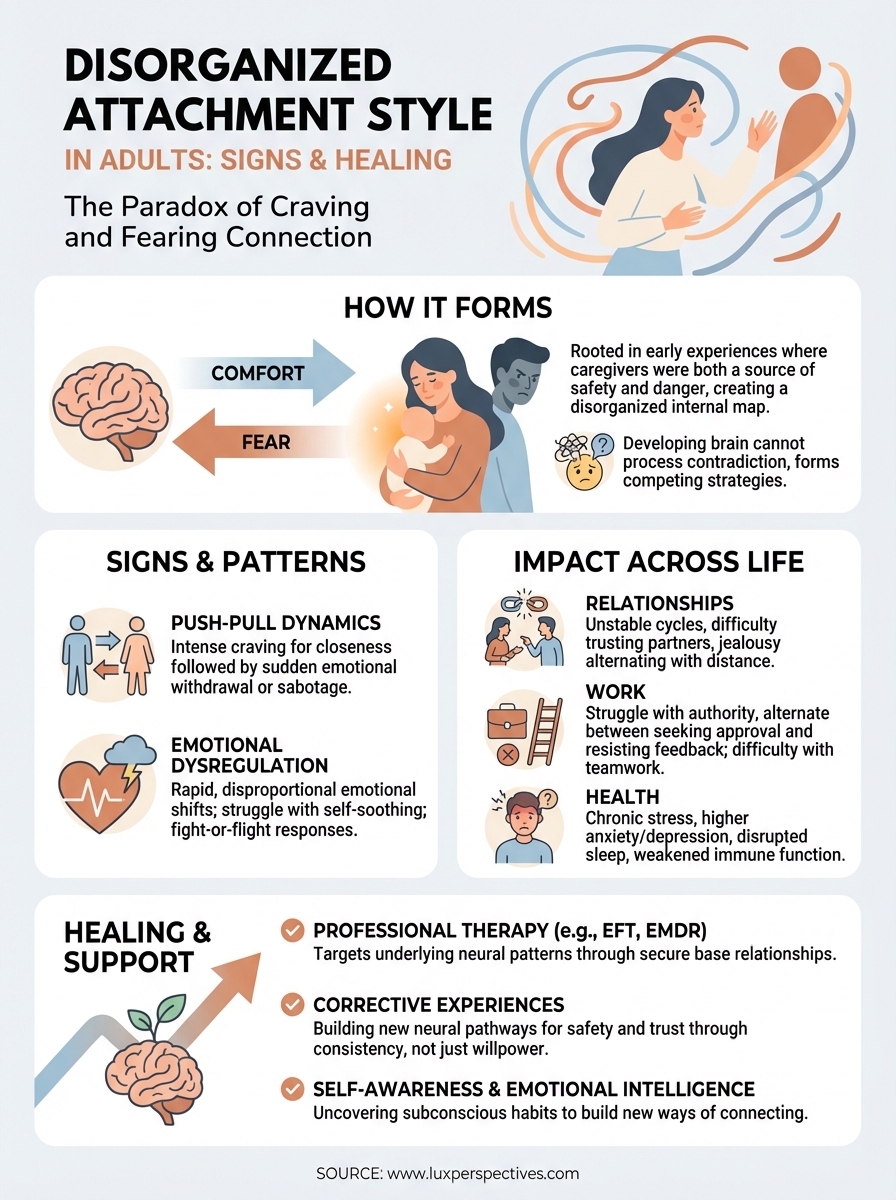
Disorganized attachment style in adults creates contradictory patterns that affect your relationships, career, and mental health, but these patterns can change with proper support. You learned to fear the very connection you need because early caregivers were both your source of safety and danger. This contradiction now plays out through push-pull behaviors, emotional dysregulation, and difficulty trusting others across all life domains.
Recognition marks the beginning of change, not the end of your journey. Professional therapy targeting attachment patterns provides the corrective experiences your nervous system needs to build new neural pathways. Healing requires consistency, patience, and working with someone who understands how trauma shapes adult relationships. Your patterns formed through relationships, which means they heal through relationships too.
Luxury Perspectives offers specialized support for adults navigating attachment challenges, providing the clinical expertise and privacy needed to address these deep-rooted patterns. Investing in this work creates lasting change that ripples through every relationship you build moving forward.