
Emotional Intelligence at Work: Why It Matters, How To Grow
You've probably worked with someone who had all the technical skills but still created friction wherever they went. Or maybe you've seen a leader who could read the room, de-escalate tension, and bring out the best in their team, without formal training. The difference between these two people often comes down to emotional intelligence at work.
EQ isn't a soft skill, it's the foundation for how we communicate, collaborate, and lead. And unlike IQ, it can be developed with intention and practice. The professionals who invest in this growth tend to advance faster and experience less interpersonal conflict along the way.
At Luxury Perspectives, founder Rhonda Baker, LMFT, works with professionals and leaders who want to apply emotional intelligence to their careers. Her approach combines clinical expertise with practical strategies that help clients reduce conflict, communicate with clarity, and lead more effectively.
This article breaks down what emotional intelligence means in a professional context, why it matters for your success, and how to strengthen these skills, starting now.
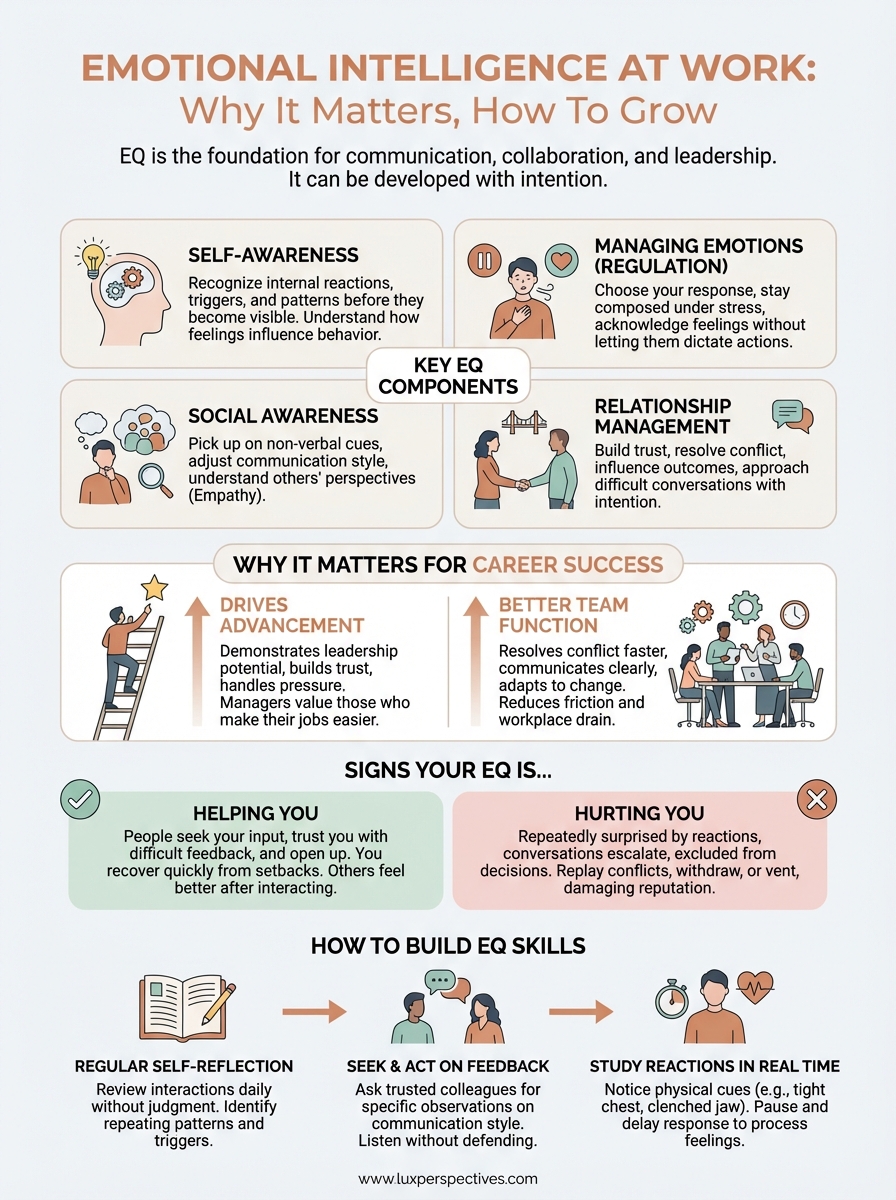
What emotional intelligence at work looks like
Emotional intelligence at work shows up in how you respond to feedback, how you navigate difficult conversations, and how you handle stress when deadlines shift or projects fall apart. It's not about suppressing your emotions or being overly agreeable. It's about recognizing what you feel, understanding why, and choosing your response instead of reacting on impulse.

Self-awareness in professional settings
You demonstrate self-awareness when you notice your internal reactions before they become visible to others. This means catching the frustration rising during a meeting where your idea gets dismissed, or recognizing when your energy dips and affects your tone in emails. Self-aware professionals can identify their triggers, whether that's feeling overlooked, micromanaged, or rushed, and they take responsibility for how those feelings influence their behavior.
Self-awareness gives you the ability to pause before reacting, which changes everything in high-stakes moments.
For example, you might notice that you tend to interrupt when you feel unheard, or that you withdraw when criticized. Once you see these patterns, you can adjust your approach instead of repeating the same cycle that damages trust or credibility.
Managing emotions under pressure
Emotional regulation is what separates professionals who stay composed under stress from those who let tension control their actions. You don't need to feel calm in every situation, but you do need to choose how you express what you're experiencing. This looks like taking a breath before responding to a tense email, or stepping away from a conversation when you feel yourself getting defensive.
Regulation also means you acknowledge your emotions without letting them dictate your decisions. If a project fails, you might feel disappointed or embarrassed, but you process those feelings privately instead of lashing out at your team or shutting down completely.
Reading others and responding effectively
Social awareness means you pick up on cues that others might miss. You notice when a colleague's tone shifts during a call, when someone seems checked out during a brainstorming session, or when your manager is stressed and needs space rather than questions. This skill allows you to adjust your communication style based on what the situation requires.
Empathy is part of this, but it's not just about feeling for others. It's about understanding their perspective so you can collaborate more effectively. You ask clarifying questions instead of assuming intent. You consider how your words land, not just what you meant to say.
Navigating relationships strategically
Relationship management is where all the other skills come together. You use emotional intelligence at work to build trust, resolve conflict, and influence outcomes without manipulation. This might look like giving feedback in a way that motivates rather than discourages, or addressing tension directly instead of letting resentment build over time.
Professionals with strong relationship skills don't avoid difficult conversations. They approach them with intention, knowing that short-term discomfort often leads to long-term clarity. They also recognize when to compromise, when to advocate for themselves, and when to let something go because it's not worth the cost to the relationship.
Why emotional intelligence matters at work
You can have technical expertise and still struggle to move forward in your career if you can't manage relationships or communicate effectively. Companies value professionals who bring stability to teams, reduce conflict, and navigate change without creating chaos. Emotional intelligence at work determines whether you're seen as someone who adds value beyond your job description or someone who creates friction that others have to manage.
EQ drives promotions and career advancement
Promotions often go to people who demonstrate leadership potential, not just technical skill. Your ability to influence others, build trust, and handle pressure signals that you're ready for more responsibility. Managers look for candidates who can manage their own reactions, provide feedback without damaging morale, and collaborate across departments without constant supervision.
The professionals who advance quickly are the ones who make their managers' jobs easier, not harder.
When you lack emotional intelligence, you might be passed over even if you're the most qualified on paper. Decision-makers hesitate to promote people who create interpersonal problems, struggle with feedback, or need constant emotional support from their teams.
Teams function better with emotionally intelligent members
Your EQ affects everyone around you. Teams with high emotional intelligence resolve conflict faster, communicate more clearly, and adapt to changes with less disruption. When you recognize tension early and address it directly, you prevent small issues from becoming long-term problems that damage trust and productivity.
Collaboration depends on your ability to read social dynamics and adjust your approach. If you dominate conversations, dismiss others' ideas without consideration, or shut down when challenged, you create an environment where people stop contributing. Emotionally intelligent professionals make space for others, ask questions that move conversations forward, and handle disagreement without making it personal.
Organizations lose talented people when the workplace becomes emotionally draining. Your ability to manage your impact on others affects retention, morale, and overall team performance in ways that show up long after individual projects end.
Signs your EQ is helping or hurting you
Your emotional intelligence at work reveals itself in patterns you might not notice until someone points them out or until you start paying attention to outcomes. These signs show up in how others respond to you, how often you're included in important decisions, and whether you leave conversations feeling drained or energized. You can measure your EQ by looking at the results you create in your professional relationships, not just your intentions.
When your EQ is working for you
You know your emotional intelligence is serving you when people seek your input during tense situations or when conflict arises. Colleagues trust you to deliver difficult feedback without making it personal, and your manager includes you in conversations that require discretion or sensitivity. You notice that others open up around you because they feel heard rather than judged.
Another indicator is your ability to recover quickly from setbacks or criticism. You process disappointment or frustration without letting it affect your work for days, and you can separate your emotional reaction from the objective feedback you received. People describe you as steady, not because you never feel stressed, but because you manage your reactions in ways that don't create additional problems for your team.
When your EQ is strong, people feel better after interacting with you, not worse.
When your EQ needs work
You might struggle with emotional intelligence if you find yourself repeatedly surprised by how others react to you. Conversations escalate unexpectedly, or people seem defensive when you think you're just being direct. You may also notice that you're excluded from meetings or decisions, even when the topic relates to your work, which often signals that decision-makers hesitate to involve you due to how you handle information or disagreement.
Another warning sign is when you replay conversations obsessively or hold onto resentment long after conflicts end. You may withdraw when stressed, leaving teammates unsure how to work with you, or you might vent frustrations in ways that damage your professional reputation. If people seem to walk on eggshells around you, that's feedback about the emotional climate you create, whether you intend to or not.
How to build emotional intelligence skills
Building emotional intelligence at work requires intentional practice rather than passive learning. You develop these skills by observing your patterns, testing new approaches, and adjusting based on what happens. The process feels uncomfortable at times because it forces you to confront behaviors you might prefer to ignore, but that discomfort signals growth rather than failure.

Practice self-reflection regularly
You strengthen self-awareness by creating space to review your interactions without judgment. This means setting aside time, even just five minutes at the end of your workday, to ask yourself what triggered strong reactions, which conversations drained your energy, and where you felt most effective. You're not looking for perfection but for patterns that repeat across situations.
Consider keeping a simple record of moments when you felt defensive, frustrated, or shut down. Write down what happened right before the emotion surfaced, how you responded, and what you wish you had done differently. Over time, you'll notice specific triggers like feeling interrupted, being questioned in front of others, or receiving last-minute changes to your work.
The goal isn't to eliminate emotional reactions but to understand them well enough that you can choose your response.
Seek feedback and act on it
Ask people you trust for specific observations about your communication style and how you handle conflict. Instead of asking if you're a good teammate, ask what they notice about your body language when you disagree, or how your tone changes under pressure. You want concrete examples rather than generalized reassurance.
When you receive feedback, resist the urge to explain or defend your intentions. Listen, ask clarifying questions, and thank the person for their honesty. Then decide which feedback aligns with patterns you've already noticed and where you'll experiment with a different approach.
Study your reactions in real time
You build regulation skills by catching yourself in the moment rather than reflecting hours later. This means noticing when your chest tightens during a meeting, when your jaw clenches while reading an email, or when you start mentally drafting a defensive response before someone finishes speaking. These physical cues tell you that an emotion is rising before it shows up in your words or actions.
Practice pausing when you notice these signals. Take a breath, excuse yourself if needed, or simply delay your response until you've processed what you're feeling and why it matters.
Workplace examples and scripts you can use
You apply emotional intelligence at work most effectively when you have specific language to draw from during challenging moments. These examples give you a starting point for conversations that require clarity without confrontation and honesty without creating unnecessary tension. Practice these approaches in lower-stakes situations first so they feel natural when pressure increases.
When you need to address a pattern with a colleague
You notice a teammate consistently misses deadlines that affect your work. Instead of complaining to others or letting frustration build, you address it directly with language that focuses on impact rather than blame. Try this: "I've noticed the last three reports came in after the deadline we agreed on, which puts me in a difficult position with my own timeline. Can we talk about what's getting in the way and how we can adjust moving forward?"
This approach acknowledges the pattern without accusing the person of being careless or unreliable. You state the consequence for you specifically, which makes the problem concrete rather than abstract, and you invite collaboration instead of demanding compliance.
Scripts work best when you adapt them to your natural speaking style rather than memorizing exact phrases.
When you receive criticism that feels unfair
Your manager gives feedback that you disagree with or that seems to ignore context. Your first instinct might be to defend yourself immediately, but that often escalates tension rather than resolving the disconnect. Instead, try: "I want to make sure I understand what you're seeing. Can you give me a specific example so I can see where the gap is between what I intended and how it landed?"
This response shows you're open to learning without automatically accepting criticism as accurate. You buy yourself time to process the feedback, and you gather information that helps you decide whether the concern is valid or based on a misunderstanding. You stay curious instead of defensive, which keeps the conversation productive.
Next steps
Developing emotional intelligence at work starts with one decision: you choose to observe yourself instead of staying on autopilot. Pick a single skill from this article, whether that's pausing before responding to tense emails or asking for specific feedback about your communication style, and practice it consistently for two weeks. You'll notice patterns emerge that reveal where your EQ helps or hurts your professional relationships.
The work becomes easier when you have structured support from someone trained in identifying blind spots and shifting ingrained patterns. If you want to apply emotional intelligence more strategically in your career, Luxury Perspectives offers private consultations focused on reducing conflict, strengthening leadership presence, and navigating workplace dynamics with clarity. Rhonda Baker works with professionals and leaders who recognize that emotional intelligence directly affects their ability to advance and lead effectively.