
Mary Ainsworth Attachment Theory: Strange Situation & Styles
The way you connect with partners, friends, and even colleagues often traces back to patterns established before you could form complete sentences. Mary Ainsworth attachment theory provided the scientific framework to understand these patterns, offering groundbreaking research that changed how psychologists view human bonding. Her work didn't just describe attachment, it classified the specific styles that shape how adults navigate intimacy, conflict, and emotional closeness.
Understanding your attachment style is one of the most practical forms of self-awareness available. Whether you find yourself pulling away when relationships deepen or feeling anxious when a partner needs space, these responses often have roots in early childhood experiences. Recognizing these patterns is the first step toward changing them, a principle that guides the therapeutic work at Luxury Perspectives with individuals and couples seeking to break free from repetitive relational cycles.
This article breaks down Ainsworth's contributions to attachment research, including her famous "Strange Situation" experiment and the three attachment styles she identified: secure, avoidant, and ambivalent. You'll gain a clear understanding of how these classifications emerged, their lasting influence on psychology, and what they reveal about your own relationship patterns today.
Why Mary Ainsworth matters to attachment theory
Before Ainsworth's work, attachment theory existed primarily as conceptual framework rather than testable science. John Bowlby had proposed that infants form emotional bonds with caregivers, but his ideas lacked empirical validation that the broader psychological community required. Mary Ainsworth attachment theory changed this by creating a standardized experimental procedure that transformed abstract concepts into observable, measurable behaviors. Her research gave psychologists a way to identify and categorize relationship patterns with scientific precision.
Your ability to discuss attachment styles in a therapy session or recognize your own relational tendencies exists because Ainsworth developed a reproducible method for studying human bonding. She didn't just observe infants interacting with caregivers in natural settings. Instead, she designed a controlled laboratory procedure that revealed how children respond to stress, separation, and reunion in ways that predict long-term relationship patterns. This methodological innovation made attachment theory relevant beyond developmental psychology, influencing fields from clinical practice to organizational behavior.
Ainsworth's Strange Situation experiment provided the first systematic classification of attachment behaviors that clinicians still reference today.
The foundation for measurable attachment research
Most psychological theories struggle to move from philosophy to science because they lack concrete measurement tools. Ainsworth solved this problem by creating the Strange Situation, an eight-episode laboratory procedure that places toddlers in mildly stressful scenarios with their primary caregiver. The experiment measures specific behaviors like proximity-seeking, contact maintenance, resistance to contact, and avoidance during separation and reunion episodes. These observable actions became the basis for classifying attachment styles, moving the field from subjective interpretation to quantifiable data.
Research teams worldwide now use Ainsworth's coding system to study attachment across cultures, socioeconomic backgrounds, and developmental stages. Her work established standardized criteria that allow researchers in different countries to compare findings and build on each other's discoveries. The three attachment classifications she identified (secure, avoidant, and ambivalent) remain foundational categories that psychologists use when assessing both childhood development and adult relationship patterns. Without this measurement framework, attachment theory would have remained an interesting idea rather than an evidence-based model.
Clinical applications that changed therapy
Ainsworth's research gave therapists a language for discussing relationship problems that clients immediately recognize. When you hear terms like "anxious attachment" or "avoidant tendencies," you're encountering concepts that trace directly back to her observational work with toddlers. Therapists use these classifications to help you understand why certain situations trigger disproportionate emotional responses or why you repeat the same relationship patterns despite conscious intentions to change.
Therapeutic approaches from emotionally focused therapy to psychodynamic treatment integrate Ainsworth's findings into their core frameworks. Clinicians assess your attachment style to predict how you'll respond to intimacy, conflict, and separation in romantic relationships. They use this information to design interventions that address the specific fears and defensive strategies associated with each attachment pattern. The practical applications extend beyond couples therapy into parenting guidance, where understanding secure attachment helps caregivers respond to their children in ways that promote emotional resilience.
Luxury Perspectives applies these principles when working with clients who feel trapped in repetitive relationship cycles. Recognizing your attachment style provides a starting point for understanding why certain interactions feel threatening and how early experiences shaped your current relational strategies. This self-awareness becomes the foundation for making intentional changes rather than simply reacting from unconscious patterns established decades ago.
Mary Ainsworth in context: life and influences
Mary Ainsworth's path to revolutionizing psychology began long before she developed the Strange Situation. Born in 1913 in Glendale, Ohio, she earned her PhD from the University of Toronto in 1939, writing a dissertation on security theory that foreshadowed her later work on attachment. Her academic training emphasized rigorous empirical research methods combined with psychoanalytic theory, a combination that gave her the tools to transform Bowlby's conceptual ideas into testable hypotheses. Understanding her background helps you recognize why mary ainsworth attachment theory became the evidence-based framework that clinicians still use decades later.

Her academic foundation and early career
Ainsworth's intellectual development occurred during a period when behavioral psychology dominated North American research. She studied under William Blatz at Toronto, where his security theory proposed that children need a secure base from which to explore the world. This concept became central to her later attachment research, but she spent years working in different roles before finding her true focus. After serving in the Canadian Women's Army Corps during World War II, she taught at the University of Toronto and later joined a research team at the Tavistock Clinic in London, where she met John Bowlby in 1950.
Ainsworth's diverse professional experiences across multiple countries gave her the cross-cultural perspective that strengthened her research methodology.
The Uganda studies that changed everything
Your understanding of attachment styles exists because Ainsworth spent 28 months in Uganda conducting naturalistic observations of mother-infant interactions from 1954 to 1955. She visited families in their homes every two weeks, meticulously documenting how infants responded to their mothers during feeding, play, and everyday activities. These longitudinal observations revealed patterns in how different caregiving styles affected infant behavior, observations that later shaped the Strange Situation experiment. She noticed that some infants used their mothers as a secure base for exploration while others showed anxiety or indifference.
The Uganda research gave Ainsworth something laboratory experiments alone could never provide: real-world context for attachment behaviors. She watched infants navigate actual separations and reunions rather than artificial scenarios, building a foundation of observational data that informed her later experimental design. When she moved to Johns Hopkins University in Baltimore, she conducted similar home observations with American families before developing the controlled laboratory procedure that made her findings replicable. This combination of naturalistic observation and experimental rigor distinguished her work from purely theoretical approaches.
Her methodological approach reflected both scientific precision and respect for cultural differences in caregiving practices. The Uganda studies demonstrated that attachment patterns existed across cultures while acknowledging that specific caregiving behaviors varied by context.
Ainsworth and Bowlby: how their work fits together
John Bowlby created the theoretical foundation that mary ainsworth attachment theory transformed into measurable science. His work focused on evolutionary explanations for why infants form emotional bonds with caregivers, arguing that attachment behaviors increased survival chances in our ancestral environment. Bowlby proposed that children need a secure base from which to explore, but he provided limited empirical evidence to support these claims. Ainsworth took his conceptual framework and developed the experimental procedures that allowed researchers to test, validate, and refine his ideas through systematic observation.
Bowlby's theoretical framework
Bowlby drew from ethology, psychoanalysis, and evolutionary biology to explain infant-caregiver bonding. He observed that infants display specific behaviors like crying, clinging, and following that keep caregivers nearby during vulnerable developmental periods. His work challenged the prevailing behaviorist view that feeding created attachment, arguing instead that infants have an innate need for emotional connection independent of physical nourishment. These ideas revolutionized developmental psychology but lacked the empirical specificity that would convince skeptical researchers.
Bowlby provided the "why" of attachment while Ainsworth delivered the "how" through rigorous observational methods.
The evolutionary perspective Bowlby championed explained attachment as an adaptive survival mechanism. Infants who maintained proximity to caregivers had better chances of protection from predators and environmental dangers. This biological framing gave attachment theory a scientific foundation that transcended cultural variations, suggesting universal patterns in human bonding across different societies and childrearing practices.
How Ainsworth validated and expanded his work
Ainsworth met Bowlby at the Tavistock Clinic in 1950, where she joined his research team studying maternal separation effects on young children. This collaboration shaped her entire career trajectory, giving her direct exposure to his theoretical framework while she brought methodological rigor to the relationship. Her Uganda and Baltimore studies provided the observational data that confirmed Bowlby's predictions about secure base behavior while revealing individual differences he hadn't fully addressed.
Where Bowlby described attachment in general terms, Ainsworth created a classification system that identified distinct patterns. She showed that not all attachments function identically, documenting how different caregiving approaches produce secure, avoidant, or ambivalent responses in children. This specificity gave clinicians practical tools for assessment and intervention, transforming Bowlby's broad theory into actionable therapeutic knowledge that professionals could apply in clinical settings.
What the Strange Situation measures
The Strange Situation doesn't assess whether your child loves you or feels connected to you in a general sense. Instead, it measures specific behavioral responses to separation stress and reunion dynamics that reveal how your child uses you as a secure base. Ainsworth designed the procedure to observe four distinct behavioral categories: proximity-seeking (how much the child tries to get close during reunion), contact maintenance (whether the child resists being put down), resistance (angry or passive responses to the caregiver), and avoidance (looking away or ignoring the caregiver's return). These behaviors emerge most clearly when children experience mild stress, which is why the experiment introduces brief separations rather than simply observing comfortable play.

Core behaviors under observation
Your child's response during the reunion episodes provides the most critical data in the entire procedure. Researchers focus on these moments because they reveal how effectively you function as a source of comfort when your child feels distressed. A securely attached child seeks you out quickly, accepts comfort readily, and returns to exploration once reassured. This pattern demonstrates that your child trusts you'll be available and responsive when needed, the foundation of secure attachment that mary ainsworth attachment theory identified as optimal for healthy development.
Ainsworth recorded how long children took to approach their caregivers, whether they maintained or resisted physical contact, and how quickly they settled after reunion. She also documented avoidant behaviors like turning away, ignoring, or moving past the caregiver without acknowledgment. These observable actions became the basis for attachment classification rather than subjective assessments of emotional quality or general relationship warmth.
The Strange Situation reveals not whether children are attached, but how they organize their attachment behaviors under stress.
Why these specific behaviors matter
These four behavioral categories predict long-term relationship patterns because they reflect underlying expectations about caregiver availability and responsiveness. When children consistently experience sensitive caregiving, they develop confident proximity-seeking and efficient comfort-seeking strategies. Alternatively, when caregivers respond inconsistently or dismissively, children adapt by either amplifying their attachment behaviors (resistant pattern) or minimizing them (avoidant pattern). Understanding this connection helps you recognize that your child's behavior in the Strange Situation reflects learned strategies for managing emotional needs rather than personality traits or temperament alone.
The eight episodes of the Strange Situation
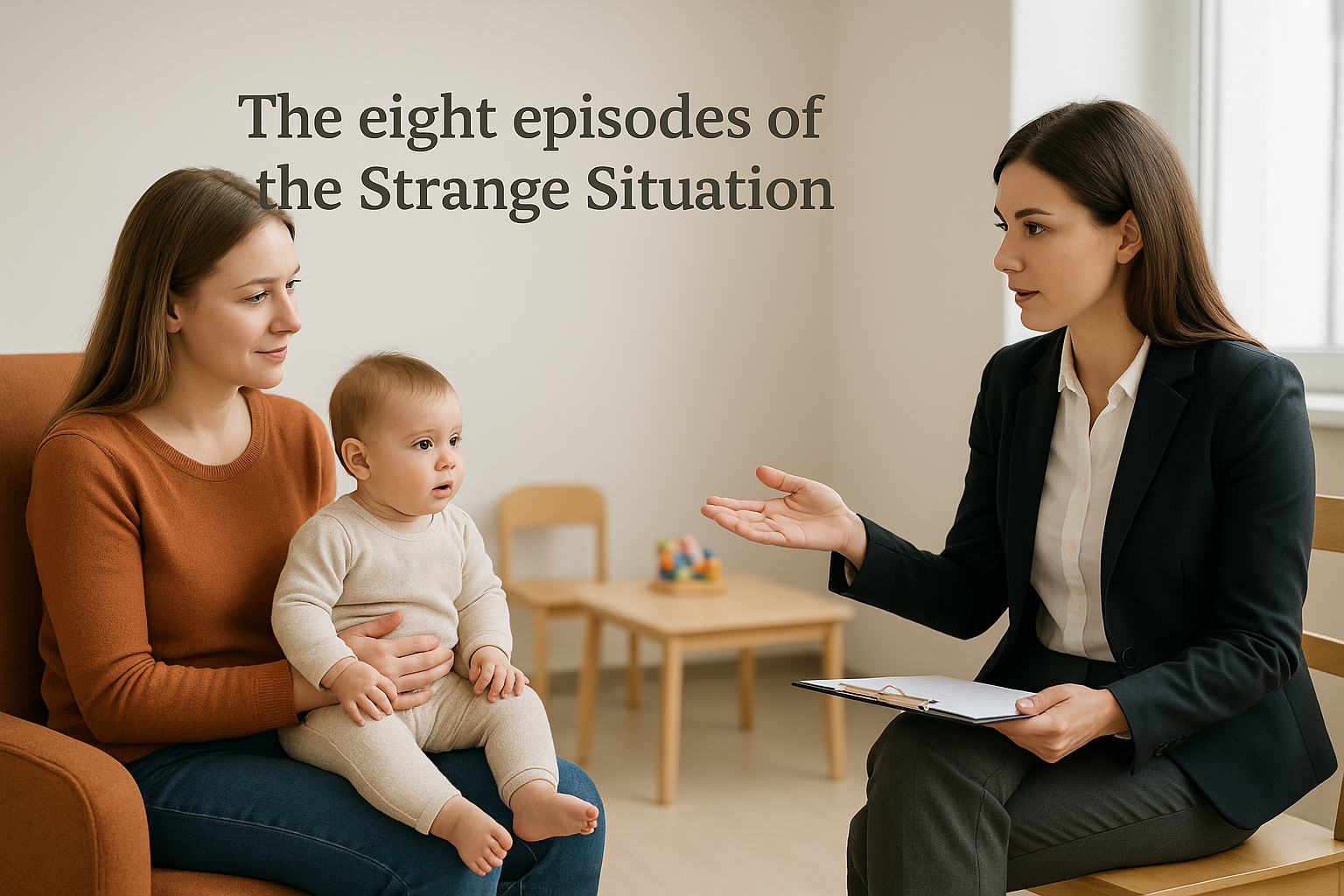
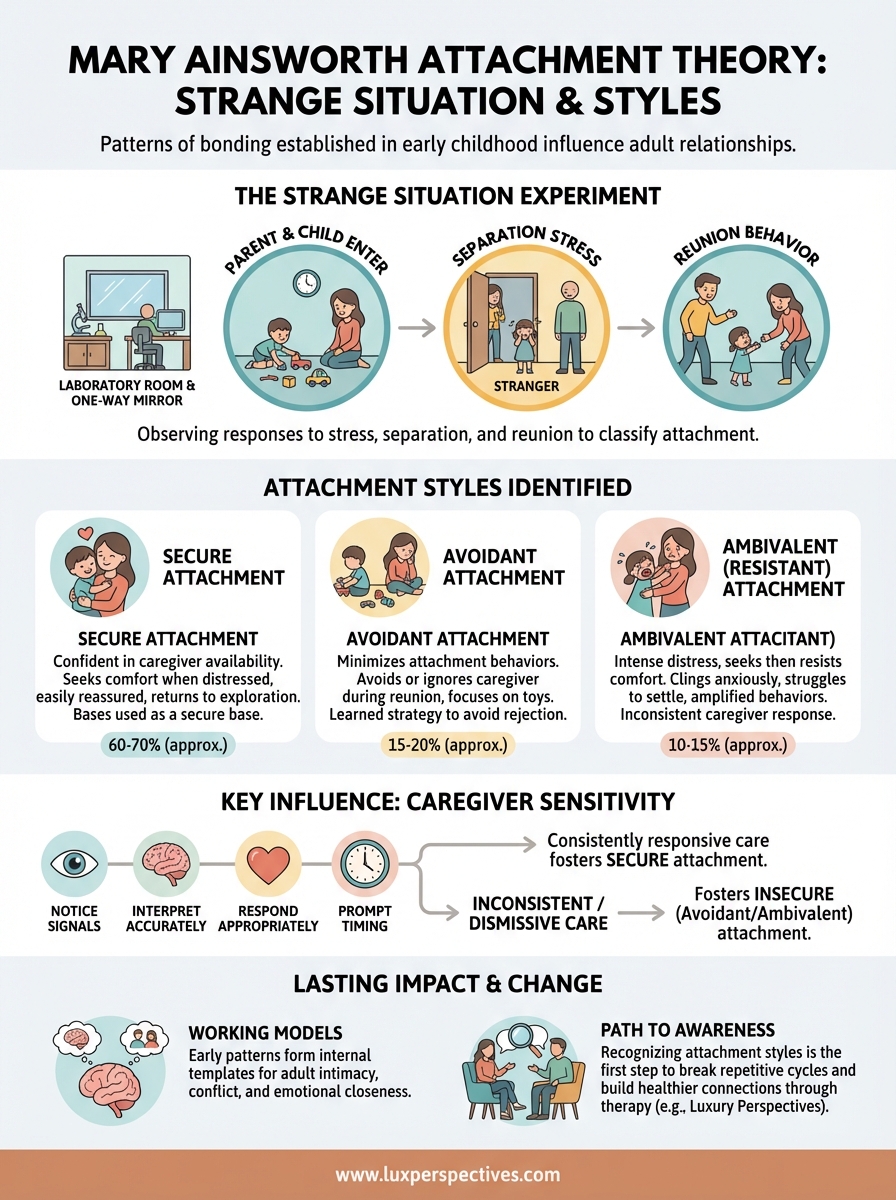
Ainsworth structured the Strange Situation as a precise sequence of eight episodes lasting approximately three minutes each, though researchers can shorten episodes if a child becomes extremely distressed. Each episode builds on the previous one, gradually increasing separation stress to reveal how your child organizes attachment behaviors when feeling vulnerable. The procedure takes place in a laboratory room equipped with toys and seating, designed to look comfortable while remaining unfamiliar enough to create mild uncertainty.
Episode structure and timing
The experiment follows a standardized protocol that every researcher implements identically, ensuring results remain comparable across studies. Each episode lasts roughly three minutes, giving children sufficient time to show their typical responses while preventing excessive distress. Researchers observe through one-way mirrors and record specific behaviors using predetermined coding systems, noting proximity-seeking, contact maintenance, resistance, and avoidance during critical moments. This standardization transformed mary ainsworth attachment theory from observational impressions into replicable science that other researchers could validate across different populations.
The Strange Situation's power comes from its precise replication of stressful moments that reveal underlying attachment organization.
What happens in each episode
The eight episodes move systematically from comfortable to stressful situations and back to comfort:
-
Introduction phase: You and your child enter an unfamiliar room where a researcher briefly explains the procedure before leaving you alone together.
-
Free play: Your child explores toys while you remain seated, establishing baseline behavior when no stress exists.
-
Stranger enters: An unfamiliar adult joins the room, talks with you briefly, then attempts to engage your child while you remain present.
-
First separation: You leave the room while the stranger stays, creating the first separation experience that tests how your child responds to your absence.
-
First reunion: You return and the stranger leaves, revealing how your child uses you for comfort after brief stress.
-
Second separation: You leave again, but this time your child remains completely alone in the room.
-
Stranger returns: The unfamiliar adult comes back while you stay absent, testing whether your child accepts comfort from someone other than you.
-
Second reunion: You return for the final episode, showing researchers how your child responds to reunion after experiencing the most stressful separation sequence.
Researchers focus particularly on episodes five and eight because reunion behaviors reveal attachment organization most clearly. Your child's response during these critical moments determines which attachment classification applies.
How researchers score and classify behavior
The Strange Situation generates meaningful data only when researchers apply consistent scoring criteria across all observations. Ainsworth developed a detailed coding system that assigns numerical ratings to each behavioral category, transforming subjective impressions into quantifiable measurements. Trained observers watch video recordings frame by frame, rating proximity-seeking, contact maintenance, resistance, and avoidance on scales from 1 to 7. These ratings combine to produce an overall attachment classification that reflects your child's predominant strategy for managing separation stress and seeking comfort.
The coding system Ainsworth developed
Ainsworth created specific behavioral indicators that coders must identify during each episode. For proximity-seeking, researchers measure how quickly your child approaches you during reunion, whether they reach up to be held, and how actively they pursue closeness. Contact maintenance receives high scores when children mold their bodies against you and resist being put down, while low scores indicate children who lean away or stiffen during physical contact. Resistance appears as angry pushing away, hitting, or throwing toys combined with simultaneous clinging, showing the ambivalence that defines this behavioral category.
Avoidance requires coders to document deliberate ignoring behaviors rather than simple distraction. Your child might turn away when you return, look past you toward toys, or actively move to the opposite side of the room. Researchers assign ratings based on intensity and duration, noting whether avoidance occurs immediately upon reunion or develops gradually. The mary ainsworth attachment theory framework emphasizes that these behaviors function as organized strategies rather than random responses, which is why precise measurement matters for accurate classification.
Attachment classification depends on behavioral patterns across multiple episodes, not isolated moments of distress or comfort.
Reliability and training requirements
You cannot simply watch the Strange Situation once and assign accurate classifications. Researchers undergo extensive training programs lasting months, where they practice coding video recordings until they achieve 80% agreement with expert coders. This reliability standard ensures that different observers watching the same child produce consistent classifications regardless of who performs the analysis. Training programs require coders to memorize behavioral definitions, practice identifying subtle cues like gaze aversion or body orientation, and calibrate their ratings against established benchmarks.
Regular reliability checks throughout research projects prevent coding drift, where observers gradually shift their standards over time. Research teams periodically have multiple coders rate the same sessions independently, then compare results to verify ongoing agreement. This quality control process maintains the scientific rigor that transformed attachment research from subjective interpretation into evidence-based assessment.
Attachment styles from the Strange Situation
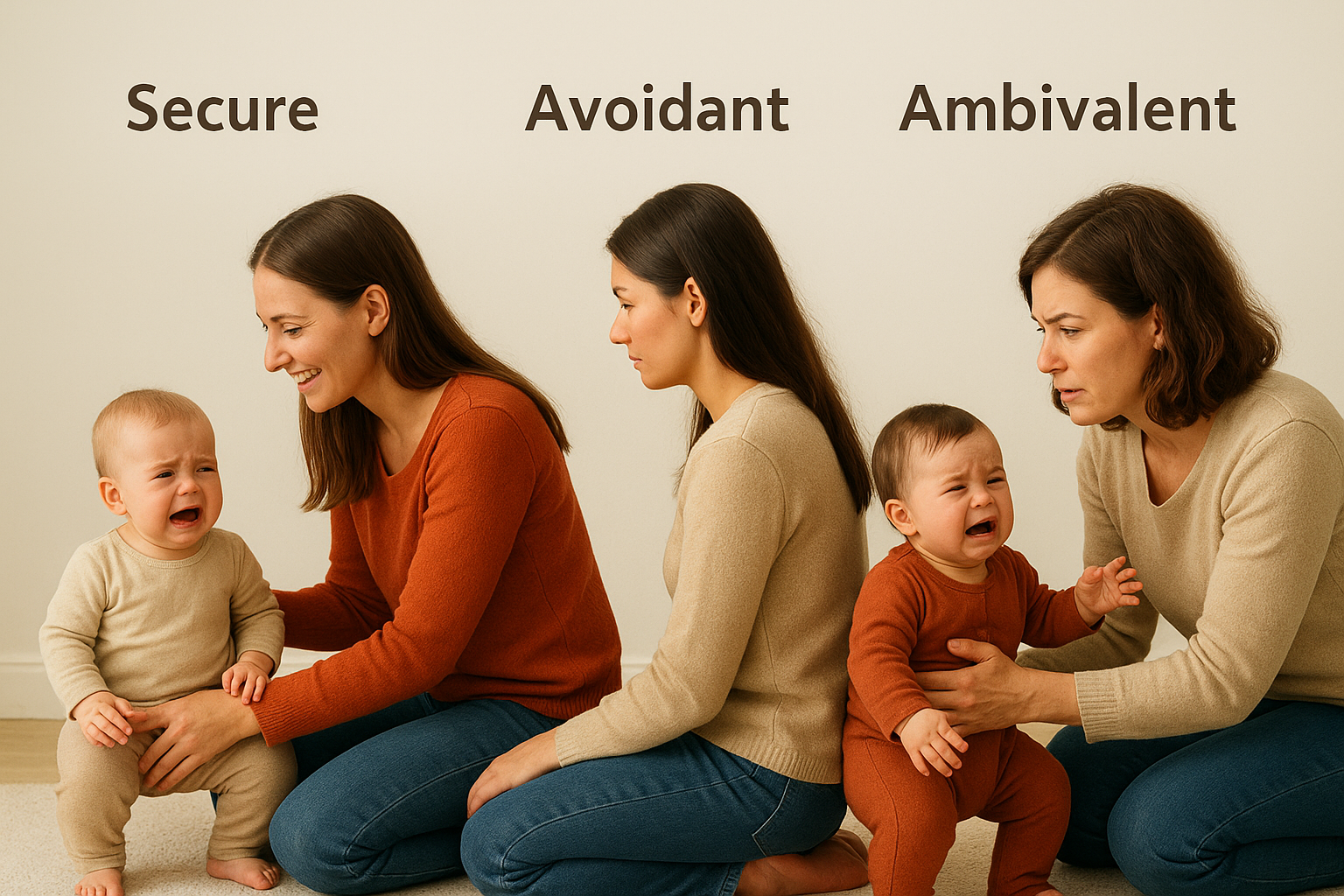
Ainsworth identified three distinct attachment patterns that emerge from Strange Situation observations: secure, avoidant, and ambivalent (also called resistant). These classifications describe organized strategies children develop for managing proximity to caregivers under stress, not personality traits or emotional capacities. Your child's attachment style reflects how consistently and sensitively you've responded to distress signals over time, creating expectations about whether seeking comfort will succeed or fail. Understanding these patterns helps you recognize that mary ainsworth attachment theory provides a roadmap for interpreting relationship behaviors rather than labeling children as problematic or healthy.
Secure attachment pattern
Children classified as securely attached show clear distress during separation but seek proximity actively during reunion episodes. They approach you quickly, accept comfort readily, and return to exploration once they feel reassured. These children demonstrate confidence that you'll respond to their needs, allowing them to balance attachment and exploration effectively. You might notice them checking your location periodically during play, using you as a secure base without requiring constant physical contact.
Secure attachment reflects learned confidence that caregivers will be available and responsive when needed.
Research consistently shows that 60 to 70 percent of children in low-risk populations receive secure classifications. These children show minimal avoidance or resistance during reunion, though they may display some ambivalence briefly before settling. The key distinguishing feature involves their efficient use of you for comfort and their ability to resume normal activity after brief reassurance.
Avoidant attachment pattern
Avoidantly attached children show little observable distress during separation and actively avoid or ignore you during reunion. They turn away, look past you toward toys, or move to the opposite side of the room when you return. This pattern doesn't indicate independence or emotional strength but rather a learned strategy for minimizing attachment behaviors after experiencing repeated rejection or dismissiveness. Your child has adapted by suppressing proximity-seeking to avoid the discomfort of failed comfort attempts.
These children represent approximately 15 to 20 percent of typical samples. They explore toys competently but show limited preference for you over the stranger, treating both adults with similar levels of engagement or disinterest.
Ambivalent or resistant attachment pattern
Ambivalently attached children display intense distress during separation followed by contradictory behaviors during reunion. They seek proximity desperately but then resist comfort by hitting, pushing away, or arching their back when held. This pattern reflects uncertainty about your availability, creating simultaneous desire for closeness and anger about inconsistent responsiveness. Your child cannot settle easily because past experiences taught them that comfort sometimes comes and sometimes doesn't.
Approximately 10 to 15 percent of children receive this classification. They struggle to return to exploration even after reunion, remaining focused on your location and availability rather than engaging with toys or the environment.
What drives attachment: caregiver sensitivity
Ainsworth discovered that caregiver sensitivity determines which attachment pattern your child develops more than any other factor. Sensitivity involves reading your child's signals accurately, interpreting them correctly, and responding promptly and appropriately to meet underlying needs. This concept transformed mary ainsworth attachment theory from observational description into actionable guidance for parents and clinicians seeking to understand how early interactions shape relationship templates. Your ability to perceive subtle distress cues and respond in ways that effectively soothe your child creates the foundation for secure attachment.
The four dimensions of sensitive caregiving
Ainsworth identified four specific components that define sensitive responsiveness rather than treating it as a vague quality. First, you must notice your child's signals, which requires sustained attention to facial expressions, body language, and vocalizations during everyday interactions. Second, you need to interpret these signals accurately, distinguishing genuine distress from momentary frustration or simple bids for attention. Third, your response must address the actual need rather than what you assume your child wants, showing that you've correctly understood the communication. Finally, prompt timing matters because delayed responses teach children that caregivers won't reliably meet needs when they arise.
Sensitivity means understanding what your child needs and responding in ways that effectively address that specific need.
Research shows that mothers rated highly sensitive have children who develop secure attachment patterns 70 to 80 percent of the time. These caregivers remain consistently attuned across different situations, adjusting their responses based on context rather than applying rigid rules. They recognize when their child needs physical comfort versus verbal reassurance, when distraction helps versus when it dismisses legitimate concerns, and when to intervene versus allowing independent problem-solving.
How sensitivity shapes each attachment style
Secure attachment emerges when you respond sensitively across repeated interactions, teaching your child that expressing needs leads to effective comfort. Your consistency allows them to develop confidence in your availability without needing constant verification. Avoidant patterns develop when you consistently dismiss, minimize, or reject distress signals, forcing your child to suppress attachment behaviors to maintain proximity without risking repeated rejection. Ambivalent attachment results from inconsistent sensitivity, where you sometimes respond perfectly but other times miss signals entirely, creating uncertainty that generates anxious monitoring and amplified distress displays. Understanding these connections helps you recognize that attachment patterns reflect learned expectations about whether vulnerability will meet acceptance or dismissal.
Common critiques and what research says now
The Strange Situation faces legitimate criticism despite its foundational role in attachment research. Critics question whether a laboratory procedure developed in 1960s Baltimore accurately captures attachment patterns across different cultures, socioeconomic contexts, and caregiving arrangements. Some researchers argue that the experiment confounds temperament with attachment, particularly when classifying children who show distress differently due to innate personality traits rather than caregiver responsiveness. These critiques don't invalidate mary ainsworth attachment theory but highlight important limitations that modern research continues addressing through expanded methodologies and diverse population studies.
Cultural bias and cross-cultural validation
Ainsworth designed the Strange Situation based on observations of middle-class American and Ugandan families, raising questions about whether her attachment classifications apply universally. Japanese researchers found higher rates of ambivalent attachment in their samples, leading some to suggest that the brief separation episodes feel more distressing in cultures where mothers rarely leave infants with strangers. German studies showed elevated avoidant classifications, possibly reflecting cultural values around early independence training rather than genuine insecurity.
Cross-cultural research reveals that attachment patterns exist globally but their distribution varies based on culturally specific caregiving norms.
More recent meta-analyses demonstrate that secure attachment remains the most common pattern worldwide, though the proportions of insecure styles shift based on cultural context. Researchers now recognize that the Strange Situation measures attachment organization relative to cultural norms rather than absolute standards of healthy development. Your child's response reflects adaptation to the caregiving environment they experience, which varies legitimately across societies without indicating pathology.
Beyond infancy and the stability debate
Early research suggested that attachment styles remained stable from infancy through adulthood, but longitudinal studies reveal more complexity. Significant life events like parental divorce, trauma, or positive therapeutic relationships can shift attachment patterns in either direction. Studies tracking children from infancy to age 26 show that roughly 70 percent maintain their original classification when family circumstances remain stable, but this drops substantially when families experience major disruptions.
Contemporary research extends attachment assessment beyond the Strange Situation through narrative interviews and self-report measures for adolescents and adults. These tools reveal that while early patterns influence adult relationships, they function as working models rather than fixed traits. You can develop more secure attachment through intentional relationship work, therapy, or consistently responsive partnerships that challenge earlier expectations about caregiver availability.
Final takeaways
Mary Ainsworth attachment theory transformed abstract bonding concepts into measurable behavioral patterns that explain how you navigate relationships today. Her Strange Situation experiment revealed three distinct attachment styles that emerge from early caregiver interactions, providing clinicians with tools to identify why certain relationship dynamics feel familiar or triggering. Understanding whether you developed secure, avoidant, or ambivalent patterns gives you practical insight into your emotional responses during conflict, separation, or intimacy.
Your attachment style functions as a working model rather than a permanent limitation. Recognizing these patterns represents the first step toward changing repetitive relationship cycles that no longer serve your goals. When you understand how early experiences shaped your expectations about emotional availability, you gain power to respond differently instead of reacting from unconscious templates established decades ago.
Luxury Perspectives helps you identify attachment patterns that influence your relationships and develop the self-awareness needed to create healthier connection strategies.